
Buyer personas are supposed to make marketing and sales easier. They give your team a clear picture of who you’re selling to as well as their goals, their frustrations, how they make decisions, and where you can reach them. Done right, they sharpen your messaging, focus your content, and help sales have better conversations.
But most buyer personas don’t do any of that. They sit in a shared drive, get referenced once in a kick-off deck, and quietly collect dust. The problem isn’t that personas are overrated. It’s that most of them are built on the wrong foundation. They’re assembled from internal assumptions and gut feel rather than real customer data, which means they sound plausible but don’t hold up when you try to act on them.
But, done correctly, buyer personas are essential tools that marketing and sales teams use to both fill their funnels and close more customers.
What Is A Buyer Persona
A buyer persona is a research-based profile that represents a specific type of customer your business sells to. It captures not just who that person is demographically, but why they buy — their goals, frustrations, decision-making process, and the criteria they use to evaluate solutions like yours. Personas give marketing, sales, and product teams a shared, specific picture of the customer they’re building and selling for.
Buyer Persona Definition: A buyer persona is a research-based profile that represents a specific type of customer your business sells to. It captures not just who that person is demographically, but why they buy — their goals, frustrations, decision-making process, and the criteria they use to evaluate solutions like yours. Personas give marketing, sales, and product teams a shared, specific picture of the customer they’re building and selling for.
It’s important to distinguish a buyer persona from a customer segment. A segment is a high-level grouping like IT Managers versus IT End Users. A persona goes deeper, exploring the backgrounds, professional goals, pain points, and perspectives that make those two groups think and behave differently from one another. Segments tell you who to target. Personas tell you how to reach and convince them.
What Should A Buyer Persona Include?
A strong buyer persona is built around the information your marketing and sales teams need to do their jobs more effectively. That means going well beyond a job title and a stock photo. The most actionable personas are built from several key components.

Professional background. What is this person’s role, and how long have they been in it? What does their typical career path look like? Understanding their professional context helps you speak their language and position your solution in terms that resonate with their day-to-day reality.
Goals and responsibilities. What are they trying to achieve, both in their role and for their organization? What does success look like for them? When you understand what they’re measured on and what keeps them up at night, you can frame your product or service as a direct path to the outcomes they care about most.
Pain points and frustrations. Where are they struggling? What problems are they trying to solve, and what have they already tried that hasn’t worked? This is often the richest territory in persona research, because it reveals the specific language and emotional triggers that make your marketing copy land.
Decision-making process. How do they evaluate options? Do they rely on peer recommendations, analyst reports, or product trials? Are they the primary decision-maker, or do they need to build internal consensus? Knowing this shapes everything from your sales cycle to the content you produce at each stage of the funnel.
Key objections. What concerns do they raise when evaluating a solution like yours? What makes them hesitate or walk away? Surfacing these objections in advance lets your sales team address them proactively rather than being caught off guard late in the process.
Information sources. Where do they go to learn and stay current — industry publications, conferences, LinkedIn, podcasts, peer networks? This tells you where to invest your marketing budget and which channels are worth prioritizing.
Buying triggers. What prompts them to start looking for a solution in the first place? Is it a new budget cycle, a leadership change, a failed initiative, or hitting a specific growth threshold? Understanding the trigger helps you reach them at exactly the right moment.
The goal is a persona specific enough that a new sales rep could read it and immediately recognize the people they’re about to start talking to and know instinctively how to approach the conversation.
What Does An Actionable Buyer Persona Look Like
The personas below illustrate what this looks like in practice. They represent two customer types a software company would typically encounter when attracting new accounts: the software end user and their manager.
Think of these as a strong starting point rather than a finished product. A baseline persona like these gives your team something concrete to align around and act on immediately, while leaving room to add depth and nuance as you gather more customer data over time. The richer your research, the more specific and useful these profiles become.
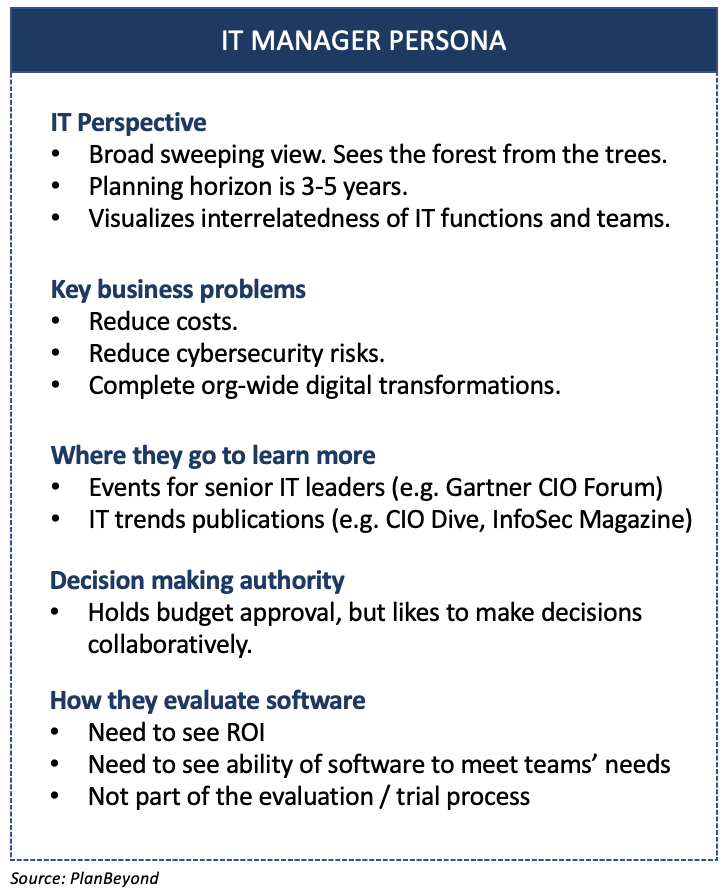
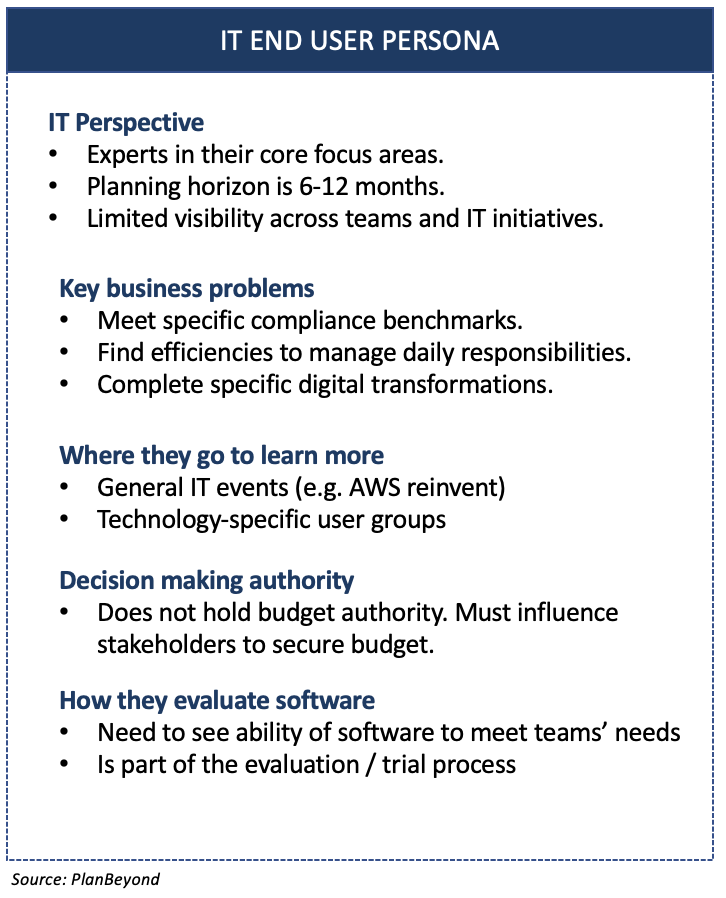
By looking at each of these personas, we see two very distinct people. One has more strategic, long term responsibilities. Meanwhile, the other has more tactical, short term responsibilities. As a result, they have different levels of authority, budgetary control, and software evaluation criteria. Further, where they go to learn more about their field varies too.
Translating A Buyer Persona Into Action
A buyer persona is only as valuable as what your team does with it. The real test of whether a persona is working isn’t how good it looks on a slide. It’s whether it’s actively shaping the decisions your marketing and sales teams make every day. If it isn’t influencing those decisions, it’s a sign the persona needs more depth or specificity.
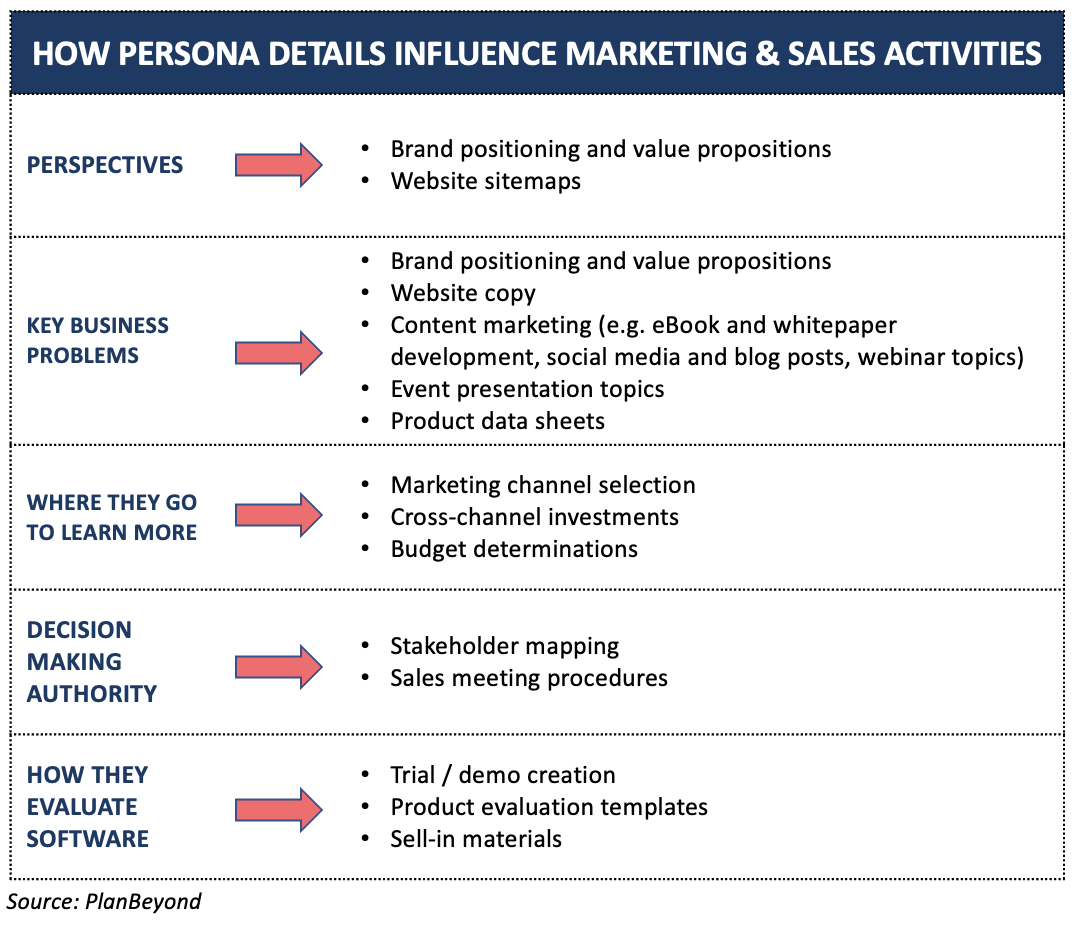
This diagram maps how individual persona elements connect to concrete marketing and sales activities. But the core idea is straightforward: every meaningful component of a persona should have a downstream application.
Marketing. When you understand a persona’s business problems, content preferences, and information sources, you can build a content strategy that speaks directly to what that person cares about. The eBooks you write, the conference panels you pursue, the LinkedIn topics you post about. All of it becomes more targeted and more likely to earn attention. You stop creating content and start creating content for someone specific.
Sales. When you understand how a persona evaluates solutions, who else is involved in their buying process, and what objections they typically raise, your sales team stops improvising. They go into every conversation with a clear sense of who they’re talking to, what that person needs to hear, and what materials will be most useful at each stage. The result is a more consistent, more confident sales process.
If you look at a persona and struggle to connect its components to specific marketing or sales actions, that’s a useful diagnostic. It usually means the persona is too generic, built on broad assumptions rather than the specific, research-backed insights that make it genuinely actionable.
When Do You Need Buyer Persona Research?
Most companies know their personas need work. Fewer know exactly when to prioritize fixing them. The answer is usually sooner than you think because outdated or underdeveloped personas quietly undermine marketing and sales performance in ways that are easy to misattribute to other causes.
These are the most common situations where buyer persona research delivers an immediate and measurable return.
You’re launching a new product or entering a new market.
When you’re going to market with something new, you can’t rely on assumptions carried over from your existing customer base. The buyers you’re trying to reach may have different goals, different objections, and different evaluation criteria than the customers you already know. Persona research done before launch gives your go-to-market plan a foundation in reality rather than educated guesswork.
Your marketing isn’t converting the way it should.
If you’re generating traffic or leads but struggling to convert them, the problem is often a mismatch between your messaging and what your buyers actually care about. Persona research surfaces the specific language, pain points, and motivations that make your marketing resonate — and reveals why your current approach may be missing the mark.
Your messaging resonates with some customers but not others.
When certain customer types engage enthusiastically while others go cold, it’s a strong signal that you’re working with an incomplete picture of your audience. Research helps you understand what differentiates those groups and how to tailor your approach accordingly, rather than continuing to optimize for an average customer that doesn’t really exist.
Your sales team is struggling to connect with prospects.
If sales cycles are lengthening, objection handling feels inconsistent, or reps are frequently caught off guard by prospect concerns, the underlying issue is often a lack of clear, research-backed persona guidance. When salespeople don’t have a reliable picture of who they’re talking to, every conversation starts from scratch.
You’re seeing higher than expected churn.
Unexpected churn is frequently a sign that the wrong customers were acquired in the first place — which points back to personas that didn’t accurately reflect who your product is best suited for. Research that clarifies your ideal customer profile helps you attract better-fit customers from the start, which pays dividends in retention and lifetime value.
Your personas haven’t been updated in more than two years.
Markets evolve, customer priorities shift, and the buyers you’re selling to today may think and behave quite differently than they did when your personas were originally built. If your team is working from personas assembled years ago from informal inputs, there’s a good chance they’re making decisions based on a customer that no longer exists.
If any of these situations sound familiar, it’s worth having a conversation about what a focused research engagement could uncover.
How To Build Buyer Personas From Research
Strong personas don’t come from brainstorming sessions or sales team intuitions. They come from a deliberate research process that starts with a clear picture of what the persona needs to accomplish and works backwards from there to determine what data to collect and how to collect it.
Start With The End In Mind
Before you write a single survey question or schedule a single interview, you need to answer one question: what decisions will these personas need to support? The answer to that question determines everything else about how the research is designed.
A content marketing team building personas to guide their editorial calendar needs different information than a product team using personas to prioritize their roadmap. A sales team looking to improve their discovery process needs different inputs than a brand team developing new messaging. If you don’t define the use case upfront, you end up collecting interesting information that nobody can act on — which is exactly how personas become shelf-ware.
Map out the specific decisions each team will make using the personas, and use that map to define your research objectives. Every question you ask should trace back to at least one of those objectives. If it doesn’t, cut it.
Choosing Between Interviews And Surveys
Once you’re clear on what you need to learn, the next decision is how to collect that information. Buyer persona research typically uses one of two approaches: qualitative interviews or quantitative surveys.
The right choice depends on how well you already understand your customer types.
Start with interviews when your personas are underdeveloped. If you’re working from high-level segments without a clear sense of what differentiates them, interviews are the right starting point. Open-ended conversations let you explore topics you didn’t think to ask about, surface language and framings that only customers would use, and follow unexpected threads that reveal the nuances that make personas genuinely distinctive. A typical interview-based persona project involves 6–10 conversations per customer segment, analyzed together to identify patterns across responses.
Use surveys to validate and add confidence. If you have a working hypothesis about your personas, perhaps from past customer conversations or CRM data, surveys let you test those assumptions at scale and quantify how strongly different attributes apply across your customer base. Larger sample sizes give you the statistical confidence to make definitive claims about how personas differ, rather than relying on directional patterns from a small interview set.
Consider a sequential approach for the most robust output. Many of the strongest persona research projects use both methods in sequence. They start with a round of exploratory interviews to uncover the key themes and differentiators, then fielding a survey to validate and quantify those findings across a broader audience. This combination gives you the depth of qualitative insight and the confidence of quantitative data, which produces personas that are both richly detailed and statistically grounded.
Who To Include In Your Research
Equally important as how you collect data is who you collect it from. Recruiting the wrong participants is one of the most common, and most damaging, mistakes in persona research, because it produces personas that accurately represent the wrong people.
Your participant list should reflect the customer types you’re trying to understand, not just the customers who are easiest to reach. That means being deliberate about which segments to include, how many participants you need from each, and what qualifying criteria ensure you’re talking to people whose experiences and perspectives are genuinely representative. If your personas need to capture differences between, say, enterprise and mid-market buyers, your research needs enough participants from each group to draw meaningful conclusions about both — not a sample that’s 80% one and 20% the other.
It’s also worth including a mix of current customers, recently churned customers, and prospects who evaluated but didn’t buy. Each group offers a different vantage point on the buying experience, and together they give you a more complete and honest picture than current customers alone.
Designing Questions That Produce Actionable Outputs
With your objectives defined and your methodology selected, the final step is designing the questions themselves. This is where many persona research projects quietly go wrong — not because the questions are bad, but because they’re disconnected from the decisions the personas need to support.
Every question should have a clear line of sight to a specific persona component and a specific downstream use. Consider the difference between these two approaches for a software company trying to understand where to invest their marketing budget:
Survey format: “Which of the following events have you attended in the past year? Select all that apply.”
-Azure Cloud Summit
-AWS re:Invent
-Microsoft Ignite
-Gartner CIO Summit
-Other (please specify)
-None — I haven’t attended any events in the past year
Interview format: “Have you attended any industry conferences or events in the past year? Tell me which ones you chose and what made them worth your time.”
Both questions are designed to answer the same business question: which events are worth sponsoring or attending? But the survey version gives you quantifiable data you can rank and compare across segments, while the interview version surfaces the reasoning behind attendance decisions, which often reveals more useful intelligence than the attendance data itself.
The principle holds across every topic area the persona needs to cover. Questions about career background should connect to how you position seniority and credibility in your sales materials. Questions about information sources should connect to channel investment decisions. Questions about evaluation criteria should connect to how your sales team structures discovery calls and proposals. If a question doesn’t have a clear connection to a real decision, it’s adding length without adding value.
Analyzing And Building The Personas
Data collection is only half the work. How you analyze and synthesize the findings determines whether the output is a rich, usable persona or a generic profile that tells your team what they already knew.
For interview-based research, analysis involves reviewing transcripts or notes across all participants in a given segment, identifying recurring themes, and noting where responses diverge in meaningful ways. The goal is to find the patterns that hold consistently within a segment while distinguishing that segment from others, the specific combination of goals, frustrations, behaviors, and preferences that makes this type of buyer distinct.
For survey-based research, analysis involves running cross-tabulations by segment to see how responses differ across customer types, identifying statistically significant differences, and building the persona profile around the attributes that most clearly differentiate each group.
In both cases, resist the temptation to average everything out. The most useful persona insights are often the ones that are strikingly specific. This includes things like a particular frustration that comes up repeatedly, an unexpected information source, a decision criterion that contradicts your team’s assumptions. Those specifics are what make a persona feel real to the people who will use it.
Ready To Build Buyer Personas Your Team Will Actually Use?
If your personas are collecting dust, your marketing feels generic, or your sales team is winging it in discovery calls, the root cause is almost always the same: the personas you’re working from weren’t built on real customer data.
At PlanBeyond, we design and execute buyer persona research that gives marketing, sales, and product teams something concrete to work with. That means personas grounded in what your customers actually think, feel, and need — not internal assumptions dressed up in a template.
Every engagement starts with a conversation about your business goals, your current understanding of your customers, and where the gaps are. From there, we design a research approach tailored to what you need to learn and build personas that connect directly to the decisions your team makes every day.
If that sounds like what you’ve been missing, we’d love to talk.
How To Build Buyer Personas FAQs
What is a buyer persona?
A buyer persona is a research-based profile that represents a specific type of customer your business sells to. It goes beyond basic demographic information to capture the goals, frustrations, decision-making processes, and behaviors that define how that person evaluates and buys products or services like yours. Unlike a market segment — which groups customers by shared characteristics — a persona brings that segment to life as a fully realized individual. The best personas give marketing, sales, and product teams a shared, specific picture of who they’re building and selling for.
What's the difference between a buyer persona and a customer segment?
A customer segment is a high-level grouping based on observable characteristics like company size, industry, job title, or geography. A buyer persona goes several layers deeper, exploring the motivations, pain points, information sources, and decision criteria that define how someone in that segment actually thinks and behaves. Think of a segment as a category and a persona as the person inside it. You need both — segments tell you who to target, while personas tell you how to reach and convince them.
Why do most buyer personas fail?
Most buyer personas fail because they’re built on internal assumptions rather than actual customer research. Teams assemble them from sales team observations, leadership intuitions, or demographic data alone, none of which capture the nuanced motivations that drive real purchase decisions. The result is a persona that feels familiar enough to seem accurate but lacks the specificity needed to inform real marketing or sales decisions. When personas don’t reflect what customers actually think and feel, teams can’t trust them, so they stop using them.
What should a buyer persona include?
A strong buyer persona should include professional background, key responsibilities, primary business goals, and the specific pain points that motivate them to seek out a solution. It should also capture how they evaluate options, who else is involved in the decision, what objections they typically raise, and where they go to learn and stay informed. The more directly these elements connect to your marketing and sales activities, the more useful the persona becomes. A persona that doesn’t answer “how should we talk to this person and where should we reach them” isn’t finished yet.
How many buyer personas does a company need?
Most companies need between two and five buyer personas, though the right number depends on how distinct your customer types truly are. If different customers have meaningfully different goals, evaluation criteria, or buying processes, they warrant separate personas. The mistake most teams make is creating too many personas — breaking customers into so many micro-profiles that the output becomes unmanageable. Start with the two or three customer types that drive the majority of your revenue, build personas around those, and expand from there only if the business case is clear.
How do you create buyer personas from research?
Buyer persona research typically uses customer interviews, surveys, or a combination of both to gather firsthand data from real customers or prospects. Interviews are ideal when you don’t yet have a clear sense of how your customer types differ from one another, since open-ended conversations surface unexpected patterns and nuances. Surveys work well when you have a working hypothesis about your personas and need to validate and quantify it at scale. In either case, the questions you ask should be driven by the specific marketing and sales decisions you need the personas to inform.
How is buyer persona research different from general market research?
General market research tends to focus on broad market dynamics — category trends, competitive positioning, or overall customer satisfaction. Buyer persona research is narrower and more human-centered, focused specifically on the individuals who buy from you and what makes them tick. It’s less concerned with how big the market is and more concerned with how a specific type of person inside that market thinks, feels, and decides. The output isn’t a chart or a statistic — it’s a profile designed to change how your team communicates and sells.
When should a company invest in buyer persona research?
Buyer persona research is worth prioritizing any time your marketing isn’t resonating, your sales team is struggling to connect with prospects, or you’re entering a new market or launching a new product. It’s also valuable when your customer base has evolved but your personas haven’t been updated to reflect that change. Many companies built their original personas years ago from informal inputs and have been operating on outdated assumptions ever since. If your team can’t agree on who your core customer is, that’s a strong signal that formal persona research is overdue.
What's the difference between a B2B and B2C buyer persona?
B2B buyer personas tend to be more complex because the purchase decision typically involves multiple stakeholders such as an end user, a manager, a procurement team, and sometimes an executive sponsor, each with different goals and concerns. B2C personas, by contrast, usually focus on a single decision-maker whose purchase is driven more by personal motivations, lifestyle factors, and emotional triggers. B2B personas also need to account for longer sales cycles, budget approval processes, and the dynamics of organizational buying. Both types require real customer data to be useful, but the research approach and the outputs look quite different.
How do you know if your buyer personas are working?
The clearest sign that buyer personas are working is that your team actually uses them. This means they are referencing personas when writing content, building sales materials, or making product decisions. Downstream indicators include improvements in content engagement, higher conversion rates, and shorter sales cycles, though these take time to materialize and are influenced by many factors. A more immediate test is whether your sales team reads the personas and immediately recognizes the people they talk to every day. If the reaction is “yes, that’s exactly our customer,” the personas are grounded in reality. If the reaction is a shrug, they need more work.
Can you use AI to build buyer personas?
AI tools can help synthesize existing customer data, identify patterns in CRM records, or draft initial persona frameworks — and they can do it quickly. But AI-generated personas are only as good as the data they’re trained on, and most companies’ internal data doesn’t capture the motivations, frustrations, and decision-making nuances that make personas genuinely useful. AI can accelerate the process, but it can’t replace conversations with real customers. The most effective approach treats AI as a starting point or a synthesis tool, not a substitute for primary research.



