
Your most loyal customers love you. They buy repeatedly, leave glowing reviews, and tell their friends. When you ask them what they think, the feedback is warm and the sentiment is strong. By every internal measure, you have something working.
So why is growth harder than it should be?
The answer is usually uncomfortable: the customers telling you everything is great are not the same population as the customers you still need to win. They found you early, believed in you before everything was perfect, and stuck around through the rough patches that would have sent a less committed buyer elsewhere. Their satisfaction is real, but it’s a poor predictor of what the broader market will do.
This is the best-customer bias. And it quietly shapes product decisions, messaging strategy, and growth planning at organizations that believe they’re being data-driven because technically, they are using customer data. Just the wrong slice of it.
Why High Customer Satisfaction Doesn’t Predict Growth
There’s an assumption buried inside most customer research programs: that the people you’re studying represent the people you still need to win. For your most loyal, most engaged customers, that assumption is almost never true.
Think about who your most satisfied customers actually are. They discovered you at some point, evaluated what you offered, decided it was worth their money, and stuck around long enough to become a reliable, repeat buyer. That journey required a certain kind of person:
- Someone predisposed to give you a chance
- Motivated enough to push through early friction
- Patient enough to stay while you figured things out
That’s not most people. The broader market you’re trying to grow into is full of buyers who are less forgiving, less motivated, and far quicker to walk away. They’re not worse customers. They’re just more typical ones. And your best customers, precisely because of their loyalty, can’t tell you how to reach them.
This creates a compounding problem. The more you listen to your best customers, the better you get at serving people who already love you:
- Your product evolves around their needs
- Your messaging reflects their language
- Your roadmap prioritizes their requests
Meanwhile, the larger pool of potential buyers (the ones who tried you and left, the ones who considered you and chose someone else, the ones who’ve never heard of you at all) remains a blind spot.
High satisfaction scores don’t signal that your growth strategy is sound. They signal that your existing customers are happy. Those are very different things.
The 3 Ways Best Customers Distort Your Strategy
Most organizations don’t realize the bias is happening. It doesn’t feel like a mistake to listen to your customers, it feels responsible. But when your research pool skews too heavily toward your most loyal buyers, the distortions show up in three predictable places.
1. Your product gets built for power users, not the typical buyer
Your most engaged customers have opinions about your product. They use it deeply, notice its limitations, and aren’t shy about requesting improvements. That feedback feels invaluable, and in isolation, it is.
The problem is that power users represent a small fraction of your actual or potential customer base. When their requests dominate your roadmap, you end up building features that delight a vocal minority while the broader market remains underserved. New buyers try your product, don’t find what they need, and leave, often without telling you why.
2. Your messaging gets optimized for people who are already convinced
Your best customers understand your value intuitively. They’ve lived it. When you test messaging with them, they respond well to language that assumes familiarity, because they have it. The problem is that your next customer doesn’t.
Messaging refined through the lens of loyal buyers tends to skip over the foundational questions that unconvinced prospects are still asking: Why should I trust this? What exactly does it do? Why is this better than what I’m doing now? You end up with messaging that resonates internally and with existing fans, but fails to convert anyone new.
3. Your churn signals get masked by your strongest accounts
When retention metrics are pulled toward your most loyal customers, the early warning signs of broader dissatisfaction become harder to spot. A segment of disengaged buyers quietly leaving doesn’t move the needle much when your top accounts are holding the average up. By the time the churn problem is visible in the numbers, it’s already bigger than it needed to be because the customers who could have told you something was wrong already left.
What Your Best Customers Can’t Tell You
Even the most candid, thoughtful loyal customer has a fundamental limitation as a research subject: they already said yes. Everything that happened before that — the hesitation, the comparisons, the objections that almost sent them somewhere else — is filtered through the positive experience they’ve had since.
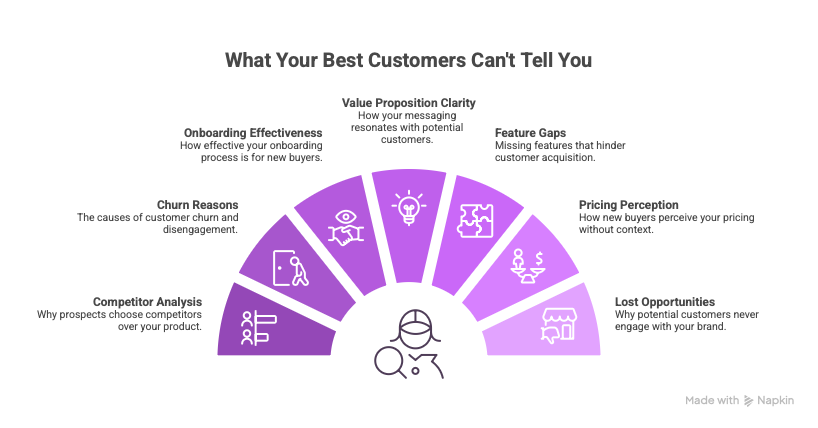
The most strategically important signals for growth often live outside your current customer base entirely. Here’s what your best customers simply cannot tell you…
Why prospects chose a competitor instead of you
The buyer who evaluated your product, got close, and went elsewhere took a set of unmet needs with them. Your loyal customers have no visibility into objections like price concerns, feature gaps, trust barriers, or a competitor’s strengths that tipped the decision.
What made someone try you and then walk away
Churned customers experienced your product with fresh eyes, hit a wall, and left. That sequence contains information your best customers can’t replicate because they either never hit that wall, or they hit it and forgave you for it.
Whether your onboarding works for the average buyer
Your most loyal customers figured out your product. They can’t accurately reconstruct what it felt like not to understand it. The friction that causes newer, less committed buyers to disengage is largely invisible to them.
How your value proposition lands on someone who’s never heard of you
Loyal customers already know the punchline. They can’t objectively evaluate whether your messaging is clear and compelling to a cold prospect who has no prior relationship with your brand.
What your product is missing for buyers you haven’t won yet
Your best customers have adapted to what you offer. They’ve built habits around your product’s current capabilities. The feature gaps that are actively costing you new customers are gaps your loyal base has long since worked around or stopped noticing.
How your pricing feels to someone without context
Customers who’ve been with you long enough to see the value don’t experience your pricing the way a new buyer does. They’ve justified the cost over time. A first-time buyer is making that calculation cold and your best customers can’t replicate that mindset.
Where you’re losing people you never even knew were considering you
Some of your biggest growth opportunities are with buyers who looked, didn’t engage, and moved on without ever becoming a lead. Your existing customers can’t tell you those people exist, let alone what turned them away.
How To Get The Customer Data You’re Actually Missing
The good news is that the blind spots created by best-customer bias are researchable. Each one maps to a specific methodology designed to capture the perspectives your loyal customers can’t provide. Here’s where to
Lost Customer Research. Churned or lapsed customers are one of the most underutilized sources of strategic intelligence available to any organization. Because they completed part of the journey with you — they bought, they experienced your product, and then they left — their feedback is grounded in real experience rather than speculation.
Lost customer research uncovers the friction points, unmet expectations, and competitive alternatives that your best customers have long since moved past. It’s the clearest window into what’s actually breaking down for buyers who don’t stick around.
Win/Loss Analysis. Every deal you lost (and every one you nearly lost) contains intelligence your current customers can’t give you. Win/loss research captures the decision-making process of buyers at the moment it matters most: when they’re actively evaluating you against alternatives.
It surfaces the objections that killed deals, the competitor strengths that tipped decisions, and the messaging gaps that left prospects unconvinced. If your close rates are softer than they should be, this is where to look first.
Prospect & Non-Customer Research. Some of your most important audiences have never bought from you, and may not even be on your radar yet.
Prospect research and usage & attitude studies with non-customers reveal how your brand and value proposition land with people who have no prior relationship with you. This is where you find out whether your messaging converts cold audiences, whether your positioning is clear to someone without context, and whether there are buyer segments you’re not reaching at all.
Customer Segmentation Research. Not all of your current customers are created equal, and the gap between your best customers and your average ones is often more revealing than you’d expect.
Customer segmentation research separates your most loyal advocates from your more transactional buyers, and identifies what actually drives retention across each group. This is how you stop optimizing exclusively for your power users and start building a strategy that works for the full range of people you need to serve.
Buyer Persona Research. If your personas were built primarily from interviews with existing customers, especially happy ones, they’re likely reflecting a skewed picture of your market. Buyer persona research that deliberately includes prospects, churned customers, and non-buyers gives you a far more accurate map of who you’re actually selling to, what they need, and where your current approach is falling short.
Each of these methodologies is filling a specific gap that satisfied customers simply can’t fill for you. Used together, they replace the confirmation loop of best-customer feedback with a complete picture of the market, including the parts that aren’t working yet.
How To Know If Your Strategy Has A Best-Customer Bias
Most organizations don’t set out to over-rely on their best customers. It happens gradually, as the most accessible and enthusiastic voices naturally get the most airtime. The following questions are designed to help you assess whether that pattern has taken hold in your organization.
Where does your customer research come from?
If your surveys, interviews, and feedback sessions are drawing primarily from your most active or longest-tenured customers, your research pool is already skewed. Healthy customer research deliberately includes newer customers, less engaged buyers, and where possible, people who didn’t convert or didn’t stay.
Who is informing your product roadmap?
If the loudest voices shaping your roadmap are power users and champion accounts, your product is being built for a small, unrepresentative slice of your market. Ask yourself: when did you last build something specifically for a buyer you haven’t won yet?
When did you last talk to a customer who left?
If the answer is “rarely” or “never,” you have a significant blind spot. Churned customers carry some of the most actionable intelligence available to your team. If they’re not a regular part of your research mix, you’re missing it entirely.
How were your buyer personas built?
If your personas were developed primarily through interviews with existing customers — especially successful, long-tenured ones — they may be more of a portrait of who stayed than an accurate picture of who you’re trying to reach.
When were they last updated, and with what sources?
How do you explain growth that’s harder than your satisfaction scores suggest it should be? This is the most telling question. If your internal metrics look strong but growth is stalling, that gap is data. It usually means the customers driving your positive metrics are not representative of the market you’re trying to expand into. Best-customer bias is one of the most common explanations, and one of the least examined.
Does your win/loss data come from your sales team alone?
Sales teams provide valuable perspective on why deals are won or lost, but they’re working from their own vantage point, not the buyer’s. If you’re not capturing win/loss intelligence directly from the prospects who made the decision, you’re getting an incomplete and often optimistic picture of what’s actually happening in competitive evaluations.
If several of these questions gave you pause, that’s a useful signal. It doesn’t mean your customer relationships aren’t valuable. They are. It means your research strategy may need to deliberately expand beyond them to give your growth strategy the complete picture it needs.
Frequently Asked Questions About Best Customer Bias
What is best-customer bias in market research?
Best-customer bias is the tendency for organizations to over-rely on feedback from their most loyal, most engaged customers when making strategic decisions. Because these customers are the most accessible and the most willing to participate in research, their perspectives end up dominating product, messaging, and growth decisions — even though they represent a small and unrepresentative slice of the broader market.
Why don't satisfied customers predict business growth?
Satisfied customers reflect the experience of people who already bought in, forgave early friction, and stayed long enough to see the value. That experience is fundamentally different from the experience of a new or unconvinced buyer. High satisfaction scores tell you your existing customers are happy — they don’t tell you whether your product, messaging, or pricing will work for the larger market you still need to win.
Why don't satisfied customers predict business growth?
Satisfied customers reflect the experience of people who already bought in, forgave early friction, and stayed long enough to see the value. That experience is fundamentally different from the experience of a new or unconvinced buyer. High satisfaction scores tell you your existing customers are happy — they don’t tell you whether your product, messaging, or pricing will work for the larger market you still need to win.
How does customer feedback create a confirmation bias loop?
When research consistently draws from the same pool of loyal customers, the findings naturally reinforce existing decisions. Products get built around power user requests, messaging gets optimized for people already familiar with the brand, and strategic assumptions go unchallenged. Over time, the organization becomes very good at serving the customers it already has — and increasingly blind to why it isn’t winning new ones.
What is the difference between customer satisfaction research and growth research?
Customer satisfaction research measures how well you’re serving the people who already buy from you. Growth research examines why people don’t buy, why they leave, and what the broader market needs that you aren’t yet delivering. Both are valuable, but they answer different questions. Companies that only do the former often mistake internal health for market readiness.
Why do companies over-rely on their best customers for feedback?
Largely because it’s easy and it feels responsible. Best customers are reachable, willing to engage, and generally positive — which makes the research feel productive. In contrast, churned customers are harder to reach, prospects are harder to recruit, and non-customers require more effort to study. The path of least resistance leads organizations toward the voices that are most available, not necessarily the most informative.
What can churned customers tell you that loyal customers can't?
Churned customers experienced your product with fresh eyes, hit a point where the value broke down, and made the decision to leave. That sequence contains critical intelligence — about onboarding friction, unmet expectations, competitive alternatives, and product gaps — that loyal customers either never encountered or long since forgot. Churned customers are one of the most underleveraged sources of strategic insight available to any organization.
How do you research people who didn't buy from you?
Prospect research and usage and attitude studies are the primary methods. Prospect research targets buyers who evaluated you and went elsewhere, capturing their decision-making process and unmet needs. Usage and attitude studies survey broader populations — including non-customers — to understand category awareness, brand perception, and purchase drivers. Together they give you a picture of the market that your existing customer base simply can’t provide.
What is customer segmentation research and how does it reduce best-customer bias?
Customer segmentation research divides your customer base into distinct groups based on behaviors, needs, attitudes, or demographics. When done well, it separates your most loyal advocates from your more transactional or at-risk buyers — revealing what actually drives retention across different segments. This prevents organizations from treating their best customers as the default template and helps build strategies that serve the full range of buyers they need to reach.
How do you build buyer personas that aren't skewed toward your best customers?
By deliberately including a wider range of research subjects — not just current customers, but also churned customers, prospects who didn’t convert, and in some cases non-customers in your target market. Personas built exclusively from happy, long-tenured customers tend to reflect who stayed, not who you’re trying to win. Broadening the research pool produces personas that are more accurate, more actionable, and more useful for acquisition-focused strategy.
What are the signs that your strategy has a best-customer bias?
Common indicators include: growth that’s harder than your satisfaction scores suggest it should be, a product roadmap dominated by power user requests, buyer personas that haven’t been updated in years, win/loss data that comes exclusively from your sales team, and a research program that rarely or never includes churned customers or non-buyers. Any one of these is worth examining. Several together suggest a significant blind spot.
Can you have high NPS and still have a best-customer bias problem?
Yes, and this is one of the most common scenarios. NPS measures the sentiment of your current customers, which skews toward people who stayed long enough to form an opinion. It says nothing about why people left, why prospects didn’t convert, or how your brand is perceived by people who’ve never bought from you. A high NPS in a stalling growth environment is often a signal that the research is measuring the wrong population.
How does best-customer bias affect marketing messaging?
When messaging is developed and tested primarily with loyal customers, it tends to assume a level of familiarity and conviction that new prospects don’t have. The language resonates with people who already understand your value — but skips over the foundational questions that unconvinced buyers are still asking. The result is messaging that performs well internally and with existing fans, but struggles to convert cold audiences who need more context, more proof, and more reason to trust.
How is best-customer bias different from simply listening to your customers?
Listening to customers is a sound practice. Best-customer bias is what happens when that listening becomes too narrow, hen the same group of highly engaged, highly satisfied buyers becomes the default source of truth for all strategic decisions. The distinction is in the range of voices being included. A healthy research program listens to current customers and churned customers, prospects and non-buyers, power users and occasional ones. Best-customer bias collapses that range down to just one end of the spectrum.



