
Your website traffic looks strong. People are exploring products, adding items to carts, starting trials, or signing up for promotions. And then… they disappear. Not at the top of the funnel, where some drop-off is expected. At the bottom, right before checkout, trial activation, or subscription completion. After your team has invested in acquisition, nurturing, and user experience.
When B2C customers abandon carts, cancel trials, or fail to convert late in their journey, most organizations default to familiar explanations: the price was too high, the timing wasn’t right, or a competitor offered a better deal. But these surface-level answers rarely explain the real reasons customers hesitate.
Late-stage non-conversion in B2C is almost never random. Every abandoned cart, lost trial, or uncompleted purchase contains structured signals about where perceived value weakened, friction emerged, or confidence in the decision faltered.
Understanding those signals systematically through market research designed to diagnose exactly why customers drop off at the last mile is the key to turning near-conversions into actual revenue.
Why Low-Funnel Non-Conversion Is Not Random
Early-stage drop-off is expected. Many site visitors browse without real intent or never enter the checkout funnel. Late-stage non-conversion, however, is fundamentally different.
When a customer invests time in building a cart, starting a trial, or engaging with your product experience, and then doesn’t complete the purchase or conversion, that outcome is typically rooted in identifiable decision friction.
Common patterns include:
- Perceived risk or uncertainty about the purchase
- Confusion or friction in the checkout or trial process
- Comparisons with competitors or alternative solutions
- Budget or timing constraints
- Unclear product value or missing justification for the purchase
In B2C contexts, “abandonment” is rarely random. Customers pause or leave because their confidence in the decision falters: the perceived benefits don’t outweigh the effort, risk, or cost, or internal priorities shift.
What’s critical is this: these behaviors are structured signals, not noise. Your analytics can tell you that someone abandoned a cart or cancelled a trial, but they cannot reveal:
- What hesitation emerged during the checkout process
- Where uncertainty about value caused pause
- Which product features or pricing elements contributed to doubt
- How competitor messaging influenced the decision
Treating late-stage non-conversion as routine abandonment risks missing opportunities to uncover systemic friction in:
- User experience and checkout flows
- Product messaging and perceived value
- Pricing clarity and subscription options
- Support and onboarding effectiveness
Low-funnel non-converters are not “lost” randomly. They are customers who came close and hesitated. Understanding that hesitation is not a tactical tweak; it is strategic intelligence that informs product, marketing, and experience optimization.
The Most Common Drivers of Cart Abandonment & Trial Drop Off
When shoppers fail to convert at the last stage, organizations often default to simple explanations: “Price was too high,” “They weren’t ready,” or “The trial didn’t appeal.” In reality, late-stage non-conversion in B2C is rarely driven by a single issue. It typically reflects a tipping point where perceived friction outweighs perceived value.
Perceived Risk Outweighs Perceived Reward
At the moment of decision, customers ask: “Is this worth it?” Risk in B2C can take multiple forms:
- Financial risk — Will this product deliver enough value to justify the spend?
- Effort risk — Will setup, learning, or onboarding be too complicated
- Experience risk — Will it meet expectations or deliver satisfaction?
- Switching or compatibility risk — Will this integrate with existing routines or tools?
Even small uncertainties at this stage can lead to abandonment, despite strong prior engagement.
Friction in Multi-Step Experiences
In B2C, purchase decisions often involve multiple micro-steps:
- Navigating product pages or options
- Selecting add-ons or subscriptions
- Entering shipping, payment, or billing details
- Engaging with trial activation or onboarding flows
Friction or confusion at any one step can stall the decision. Without insight into where hesitation occurs, teams may misattribute abandonment to price or promotion instead of process or UX barriers.
Value Ambiguity and Missing Justification
Shoppers rarely act on features alone; they act on perceived outcomes. When value is unclear or benefits aren’t compelling, momentum slows:
- Product benefits aren’t linked to real-life results
- Pricing tiers or subscription models are confusing
- Trial or demo experiences don’t clearly demonstrate ROI
- Marketing messaging feels generic or unpersonalized
If customers cannot justify the purchase to themselves, the default becomes inaction. The product is capable; the decision process is stalled.
Competitor Influence Late in the Funnel
Even near the finish line, competitors can influence decisions:
- Alternative offers or discounts appear during checkout
- Free trials or demos from competitors showcase a different experience
- Social proof, reviews, or ratings shift perception of relative value
Without direct feedback from non-converting users, organizations rarely see how competitors influenced final-stage decision-making.
“Not Now” as a Default Customer Behavior
Timing objections are common in B2C: a shopper may “intend to return later,” but this often masks deeper hesitation:
- Uncertainty about value or outcomes
- Friction in the checkout or trial process
- Need for approval from others (family, teammates, etc.)
- Competing priorities in time or budget
Accepting “not now” at face value misses recurring structural barriers that could be optimized to increase conversions consistently.
How to Use Market Research to Diagnose Low-Funnel Drop-Off
If late-stage B2C non-conversion is fundamentally about hesitation, friction, and perceived risk, analytics alone will never tell the full story. Conversion reports can tell you what happened but they cannot tell you why.
Structured research is required to systematically capture how high-intent customers experienced your product, trial, or checkout process — in their own words. Done correctly, this is not a generic feedback survey. It is a deliberate research initiative designed to uncover root causes, quantify their impact, and identify precise opportunities for optimization.
A rigorous B2C approach typically follows four steps.
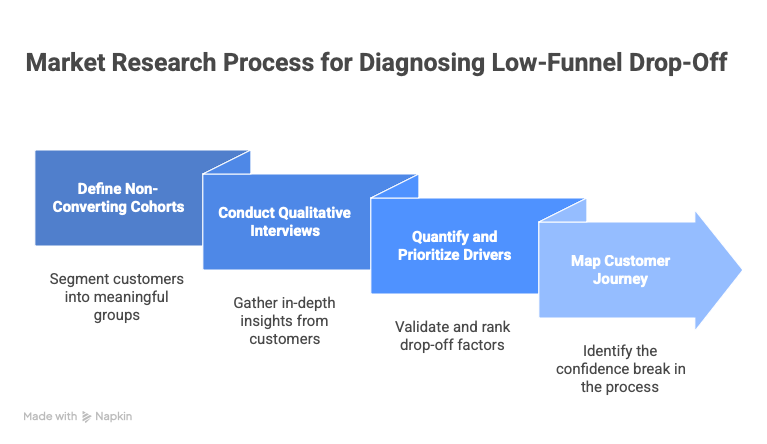
Step 1: Define the Right Non-Converting Cohorts
Not all abandoned carts or incomplete trials are the same. Treating them as a single category obscures meaningful differences. Cohort segmentation allows research to pinpoint patterns and tailor interventions.
High-value B2C cohorts might include:
- Shoppers who reached checkout but abandoned the cart
- Trialists who engaged meaningfully but did not activate fully
- Customers who added premium items but did not complete purchase
- Users who interacted with promotions or onboarding flows but failed to convert
Further segmentation sharpens insight. Examples include:
- New vs. returning visitors
- Product categories or bundles
- Device type or platform
- Acquisition channel (email, paid, organic)
- Price tier or subscription level
Clarity at the cohort level ensures research surfaces actionable patterns, rather than generic dissatisfaction.
Step 2: Conduct Qualitative Customer Interviews
Quantitative analytics tells you what happened. Qualitative research reveals why. In-depth interviews or moderated sessions with non-converting customers are often the most revealing component. The goal is not to ask, “Why didn’t you buy?” That usually generates polite, surface-level answers.
Instead, effective interviews reconstruct the customer journey:
- What initially motivated them to explore your product or trial?
- How did they evaluate options, both within your site and against competitors?
- Which steps in the checkout, trial, or activation process caused hesitation?
- How did friction or confusion affect confidence in the decision?
- Were there external factors (timing, budget, household input, competing priorities) that influenced their choice?
These conversations often uncover insights that analytics miss:
- Confusion or friction in multi-step flows
- Features or benefits that weren’t clear or compelling
- Moments where competitor messaging shifted perception
- Gaps in trust or confidence in your brand
Qualitative research exposes behavioral and emotional drivers, not just functional objections, and captures the language customers use — critical for refining messaging, UX, and onboarding flows.
Step 3: Quantify and Prioritize Drivers at Scale
Once qualitative themes are identified, quantitative research validates their prevalence and relative importance across your audience. This stage moves the organization from anecdote to evidence. Organizations can:
- Rank the most influential drop-off drivers
- Quantify what percentage of users experience each barrier
- Compare drivers across cohorts (e.g., new vs. returning, mobile vs. desktop)
- Evaluate which barriers have the largest impact on conversion probability
- Test alternative messaging, trial experiences, or UX flows
For example, research may reveal:
- 40% of cart abandonments are triggered by unexpected shipping costs
- Trial drop-off is concentrated in users who don’t complete onboarding within 48 hours
- Confusion over subscription tiers accounts for 25% of incomplete purchases
- Social proof or competitor offers disproportionately affect certain segments
Quantification prevents overreaction to isolated feedback and ensures teams prioritize the changes that will drive the largest lift in conversions.
Step 4: Map the Customer Journey and Identify the Confidence Break
Beyond individual barriers, effective research reconstructs the entire journey to reveal where confidence falters. For B2C, this typically involves mapping:
- Initial product discovers
- Consideration of alternatives
- Adding items to cart or starting a trial
- Engaging with onboarding, tutorials, or trial content
- Checkout or activation
- Final purchase or subscription confirmation
At each stage, confidence can either strengthen or weaken. Journey analysis often surfaces distinct “confidence breaks.” For instance:
- Confidence is high during browsing, but payment options feel confusing
- Trialists enjoy the product but struggle to complete onboarding
- Free shipping or discount thresholds create friction near checkout
- Product value is clear, but competitor promotions create doubt
Once identified, these inflection points provide highly specific intervention targets, such as:
- Streamlining checkout or trial flows
- Clarifying pricing, shipping, or subscription options
- Enhancing onboarding and guidance during trials
- Highlighting product benefits and social proof at the right moments
Instead of broadly trying to “increase conversions,” organizations can focus on targeted actions that remove hesitation, reinforce confidence, and drive measurable improvement in late-funnel metrics.
Turning Insight into Action: What B2C Organizations Should Actually Do
Insight alone doesn’t increase conversions. Analytics dashboards don’t recover abandoned carts. Even the most thorough research only creates value when it drives structural change.
The true advantage of studying late-stage non-converters is not simply understanding why customers drop off. It’s identifying where confidence or motivation breaks down — and redesigning the experience to address those gaps.
When B2C organizations translate research into action, several strategic levers typically emerge:
1. Reduce Friction in the Checkout or Trial Flow
Research often reveals specific points where hesitation or confusion occurs. Fixing these bottlenecks can dramatically improve conversion:
- Simplify multi-step checkout processes or trial activation flows
- Reduce unnecessary form fields or clicks
- Clarify payment, shipping, or subscription options upfront
- Provide clear next steps and progress indicators during trials
- When friction is minimized, customers can complete their journey with confidence.
2. Clarify Value and Benefits
Late-stage non-conversion often stems from value ambiguity. Customers may understand your product conceptually but are unsure if it meets their personal needs. Research-driven action may include:
- Highlighting key benefits and differentiators at the point of decision
- Personalizing messaging for specific segments (e.g., first-time buyers, premium users)
- Using social proof, testimonials, or success stories to reinforce credibility
- Demonstrating outcomes clearly in trial or onboarding experiences
When customers can confidently justify the purchase to themselves, conversion rates improve, without relying on discounts or pressure tactics.
3. Strengthen Incentives and Pricing Structure
Sometimes late-stage hesitation is about perceived risk or value misalignment with cost. Research may reveal:
- Confusing subscription tiers or add-on options
- Price thresholds that create abandonment
- Discount or promotion timing that affects decision urgency
Actions might include:
- Simplifying tier structures
- Making costs transparent upfront
- Offering risk-reducing options, like free trials, money-back guarantees, or phased commitments
When the perceived reward clearly outweighs the perceived risk, customers are more likely to convert.
4. Optimize Trial and Onboarding Experiences
For products with free trials or demos, research often shows that drop-off occurs during engagement, not acquisition:
- Identify trial steps where users disengage
- Provide timely prompts, tutorials, or nudges to guide completion
- Highlight the most impactful features early to demonstrate value quickly
- Use in-app messaging or emails to address common friction points
Effective onboarding turns trial users into confident, paying customers by reinforcing value and reducing decision friction.
5. Build a Continuous Feedback Loop
The most successful B2C organizations don’t treat non-conversion research as a one-off initiative. They institutionalize it:
- Conduct ongoing post-abandonment surveys or interviews
- Analyze trial or checkout drop-off data continuously
- Integrate behavioral analytics with customer feedback
- Test interventions iteratively and measure lift
When insights are captured and acted on continuously, small improvements compound, creating systemic conversion gains over time.
From Abandoned Carts to Strategic Growth
Late-stage non-converting shoppers are often seen as disappointments — lost revenue and sunk acquisition cost.
In reality, they represent one of the most concentrated sources of actionable insight available to a B2C organization. These customers invested time, engaged with your product or trial, and came close to converting. But something — friction, hesitation, or uncertainty — stopped them.
When organizations move beyond assumptions and systematically investigate this hesitation, they gain more than incremental lift:
- They understand how their value is perceived
- They identify where confidence falters
- They uncover structural opportunities to optimize the experience
In B2C environments, where conversion rates are low and acquisition costs are high, this clarity is essential for scalable growth.
Research, when directly connected to design, UX, pricing, and messaging, transforms abandoned carts and trial drop-offs from lost revenue into strategic growth intelligence. And that shift from guessing to knowing is where durable, repeatable growth begins.
FAQs – Late-Stage B2C Conversion and Abandonment
What is late-stage non-conversion in B2C?
Late-stage non-conversion happens when a user has shown strong intent — like adding items to a cart, starting a free trial, or progressing through onboarding — but ultimately does not complete the purchase or subscription. Unlike early drop-offs, these users have already invested time and attention, which means their hesitation often reveals structured insights about friction, perceived risk, or unclear value in your experience. Understanding this stage is critical because these users are closest to converting and small interventions can have outsized impact.
Why do customers abandon online shopping carts?
Cart abandonment occurs when users reach the checkout but leave before completing the purchase. Common causes include unexpected costs like shipping or taxes, complicated checkout flows, account creation requirements, slow page load times, or uncertainty about product suitability. Additionally, users may simply be distracted or comparing other options. Research shows that analyzing these drop-offs often uncovers patterns that can be addressed systematically to improve conversion rates.
Why do free trial users fail to convert to paid customers?
Trial users may not convert if they fail to realize the product’s value quickly, get stuck during setup, or experience confusing pricing or feature limitations. In some cases, users disengage because onboarding communications are unclear or they encounter technical barriers. Even high-intent users can fail to convert if their expectations are not met, or if the trial experience does not clearly demonstrate benefits. Addressing these barriers can significantly increase trial-to-paid conversion.
How can I tell if cart abandonment is random or systematic?
Random abandonment occurs when users leave due to personal distraction or timing. Systematic abandonment is tied to patterns in behavior, such as repeated exits at a specific checkout step, confusion over payment options, or drop-off after encountering certain friction points. By analyzing behavior trends and supplementing with direct feedback, you can determine whether abandonment is random or caused by consistent obstacles in your experience, allowing targeted interventions rather than guessing.
How can I identify which shoppers are high-value non-converters?
High-value non-converting shoppers are those whose behavior indicates significant intent but who do not complete the final step. Segmenting by behavior (cart abandoners, trial drop-offs, feature usage), acquisition channel, device, subscription tier, and demographic or psychographic characteristics helps identify patterns. By isolating these groups, you can tailor interventions, prioritize resources, and ensure fixes are targeted at the users who are most likely to deliver measurable revenue when converted.
How does perceived risk affect late-stage B2C conversion?
Perceived risk can halt a user’s decision even after significant engagement. Customers may worry about wasting money, facing complicated returns, not getting expected value, or experiencing technical issues. This perception can be amplified for expensive products, first-time buyers, or complex services. By addressing risk through clear policies, guarantees, and reassurances within your UX, messaging, and trial experiences, you reduce friction and help users feel confident completing their purchase or subscription.
How can market research help reduce abandonment rates?
Market research uncovers the underlying reasons for non-conversion by combining analytics with qualitative insights. Surveys, interviews, and user testing reveal friction points, hesitation, or confusion that cannot be seen in metrics alone. For example, a user might abandon a cart because the checkout form is confusing, even though analytics only show “drop-off.” Research allows you to systematically identify and prioritize interventions that will have the greatest impact on converting high-intent users.
What is a “confidence break” in the customer journey?
A confidence break is the point where a user loses trust, clarity, or motivation, leading them to abandon a cart, trial, or subscription. This can occur during checkout, trial setup, or onboarding when friction is encountered, expectations are unmet, or perceived value is unclear. Identifying these breaks is critical because they highlight the exact stage where users need reassurance, guidance, or simplification to continue their journey.
How do competitor offers influence late-stage B2C conversions?
Competitor offers can reshape how a user perceives value, even late in the process. For example, a competitor may advertise a lower price, faster shipping, or easier onboarding, prompting users to hesitate or switch. Understanding these influences through market research or benchmarking allows you to adjust messaging, emphasize differentiation, and reinforce value in real-time, reducing abandonment and capturing more conversions.
Are pricing and promotions the main causes of abandonment?
Pricing can play a role, but abandonment is rarely caused by price alone. Friction in checkout, unclear product value, confusing trial flows, or lack of guidance often contribute more significantly. Promotions and discounts can temporarily reduce abandonment, but addressing systemic friction, perceived risk, and unclear benefits usually provides longer-lasting improvements in conversion.
How can I quantify why customers abandon carts or trials?
Once qualitative research identifies common friction points, surveys, experiments, and analytics can measure prevalence, severity, and impact across cohorts. For instance, you might find that 35% of cart abandoners leave due to confusing shipping options, while 25% drop off because of unclear pricing. Quantifying drivers helps prioritize fixes that deliver the largest impact, rather than acting on anecdotal or isolated feedback.
How often should B2C companies research non-converting users?
Ongoing research is ideal. Continuous post-abandonment surveys, trial feedback, and behavioral analysis help identify emerging friction points before they become systemic. Regularly capturing insights ensures your team can proactively optimize the experience and prevent revenue loss from recurring patterns of abandonment.
How do external factors like timing and budget affect late-stage B2C conversions?
sers may delay purchases or subscriptions due to personal budgets, pay cycles, seasonal timing, or competing priorities. Even high-intent users can abandon because the purchase doesn’t fit their immediate context. Understanding these external factors allows brands to create strategies like follow-up reminders, time-sensitive offers, or flexible payment options to recapture users at the right moment.
How can companies continuously improve late-stage conversion?
By institutionalizing feedback loops, combining behavior analytics with direct user research, and testing targeted interventions iteratively, organizations create a cycle of continuous improvement. Each insight informs product, UX, pricing, and messaging updates, reducing abandonment over time and converting more high-intent users into paying customers.



