
Every website redesign runs into the same problem. It takes too much time to get the messaging right, accurate to the product, correctly differentiated by audience, and aligned to a real brand vision. Most launch timelines don’t allow for it, so teams end up making a key tradeoff. Shipping fast with messaging that falls short, or getting it right months after the market window that mattered has closed.
That tradeoff isn’t necessary. AI-augmented research accelerates the work that makes a website actually convert, from stakeholder interviews through sitemap and page-level execution, without cutting the rigor that drives on-site conversions.
What makes a website convert
A website converts when three things line up: positioning that reflects a real strategic point of view, messaging that speaks correctly to each distinct audience, and product promotion compelling enough to make someone act. Most sites get one or two of these right. Few get all three, because each one pulls against the others.
- Positioning requires a clear, defensible point of view, not a list of features
- Audience targeting requires speaking differently to different buyers without fragmenting the brand into inconsistent messages
- Product promotion requires translating strategy into pages, CTAs, and layouts that actually move someone through a decision
This alignment is hard for a structural reason, not a talent reason. Each of the three usually lives with a different owner: positioning sits with brand strategy, audience targeting sits with product marketing, and page-level promotion sits with design and dev. When those owners work in sequence instead of from a shared foundation, each handoff introduces drift. The dev team builds pages before positioning is settled. The audience segmentation happens after the sitemap is already locked. By launch, the three pieces technically coexist but don’t reinforce each other.
The fix isn’t more coordination meetings. It’s sequencing the work so each piece is built directly on the one before it, fast enough that nothing goes stale before the next step starts. That means:
- Positioning gets established first, from research, not assumption
- Audience-specific messaging derives directly from that positioning, not a separate exercise
- Page-level structure and promotional tactics get built to execute the positioning and audience strategy, not designed in parallel and reconciled later
Getting that sequencing right is where most teams struggle. Not because the logic is unclear. Rather, because doing rigorous work at each step takes more time than a launch timeline allows. That’s the real obstacle: following the right process without the process becoming the bottleneck.
The website-building tradeoff most teams accept that hurts conversion
The bottleneck sits in the research and synthesis needed to drive effective strategy.
Interviews with key business and product stakeholders take time to schedule and conduct. Product documentation takes time to review and reconcile against what stakeholders say. Translating findings into positioning, then into audience-specific messaging, then into page-level structure, takes time at every handoff.
None of that work is optional if a site is going to hold up. However, that’s exactly why it becomes the bottleneck. It’s necessary. But it’s slow. Most launch timelines don’t leave room for both.
So teams resolve the tension by cutting something instead of solving it:
- Cut the research. Skip or shortcut the interviews and product review, and build on assumption instead. The timeline holds, but the messaging drifts from what the product actually does.
- Cut the audience differentiation. Write one message for everyone instead of tailoring it by segment. Faster to produce, but weaker for every audience it doesn’t speak to directly.
- Cut the sequencing. Let design and dev start before positioning is settled, so the schedule keeps moving even though the pieces below it haven’t stabilized yet.
Each of these trades is a reasonable response to real time pressure. None of them actually resolves the underlying tension. They just move the cost downstream, into a launch that ships on time but underperforms, or into a second round of revisions once the gaps become visible.
The bottleneck itself isn’t the problem to solve. It’s the target. The real fix has to shorten the research and synthesis work without cutting any of the pieces that make a website work.
Breaking down the bottleneck: start with a strategy grounded in truth
Shortening the research without cutting it starts with the piece most redesigns get wrong: making sure the messaging actually matches what the product does. This is usually where speed and accuracy first come into tension, and it’s the clearest place to see what “faster without cutting corners” looks like in practice.
Run Human-Led Interviews
The first step still requires a human touch. Moderator-led interviews with three key internal stakeholders, not one.
- Product professionals know the features and functionality in detail: what the product does, how it works, where it technically wins or falls short of competitors
- Sales gets first touch with prospects and hears the problems customers are trying to solve before they’ve bought anything
- Customer success holds the most persistent touchpoint post-sale and sees which needs recur, and how the product keeps solving problems over time
Each role sees a different slice of the truth. Product knows the capability, sales knows the pitch that lands, customer success knows what actually holds up after purchase. Skip any one of them and the messaging optimizes for only part of the picture.
A human has to conduct these interviews. Reading nuance, following up on an unexpected answer, building the trust that gets someone to speak candidly requires a human touch. None of it should get handed to AI.
Finding what aligns and what doesn’t across three roles is where the time goes, and where AI earns its place. Product, sales, and customer success rarely describe the product identically. Some of that is a healthy sign of different vantage points. Some of it is a real inconsistency that needs resolving before it reaches copy. Manually cross-referencing three sets of interview notes to tell the difference is slow. AI-assisted synthesis:
- Surfaces where the three roles agree, giving positioning claims that are well-corroborated instead of resting on one person’s framing
- Flags where they diverge, so the inconsistency gets resolved deliberately instead of picked at random or missed entirely
- Compresses what would normally be days of manual comparison into a synthesis pass a human can review and validate
Leverage AI-Assisted Documentation Reviews
Documentation review runs the same way. Product documentation captures feature and functionality detail, and it often includes things that never came up in any interview because they’re too embedded in day-to-day knowledge to mention out loud. Reviewing it manually against three sets of interview findings is slow work. AI-assisted review augments what’s already been established, confirming what’s true about the product and catching gaps or inconsistencies, in a fraction of the time a manual pass would take.
The result: Underlying intel built on a full, corroborated picture of the product, at the speed a solely human-led approach could never match.
Build strategic brand foundations and value propositions
Corroborated intel is only useful once it’s structured into something the rest of the site can be built from. That structure has two layers: a brand foundation that establishes the core positioning and pillars, and audience-specific value propositions that translate those pillars for each customer vertical.
The brand foundation comes first, and it stays fixed. It has three parts:
- A positioning statement that defines what the product is and does, in one sentence a prospect or stakeholder could repeat back accurately
- A category truth that names why the problem exists in the first place, and why it matters enough to act on
- Brand pillars, a small set of core claims (typically three to five) that the rest of the site’s messaging has to trace back to, each with a short explanation of what it means and why it’s true
Value propositions come next, one set per customer vertical. The same brand pillars mean something different to unique target audiences or industry verticals. Each audience or vertical gets its own set of value propositions, translating the fixed pillars into the language and stakes that vertical actually cares about, without changing what’s fundamentally true about the product.
This is where a template becomes the fastest way to work. Rather than starting from a blank page for each new site or vertical, the brand foundation and value proposition structure gets built once as a reusable template, then handed to AI along with the corroborated intel from interviews and documentation review.
For instance…
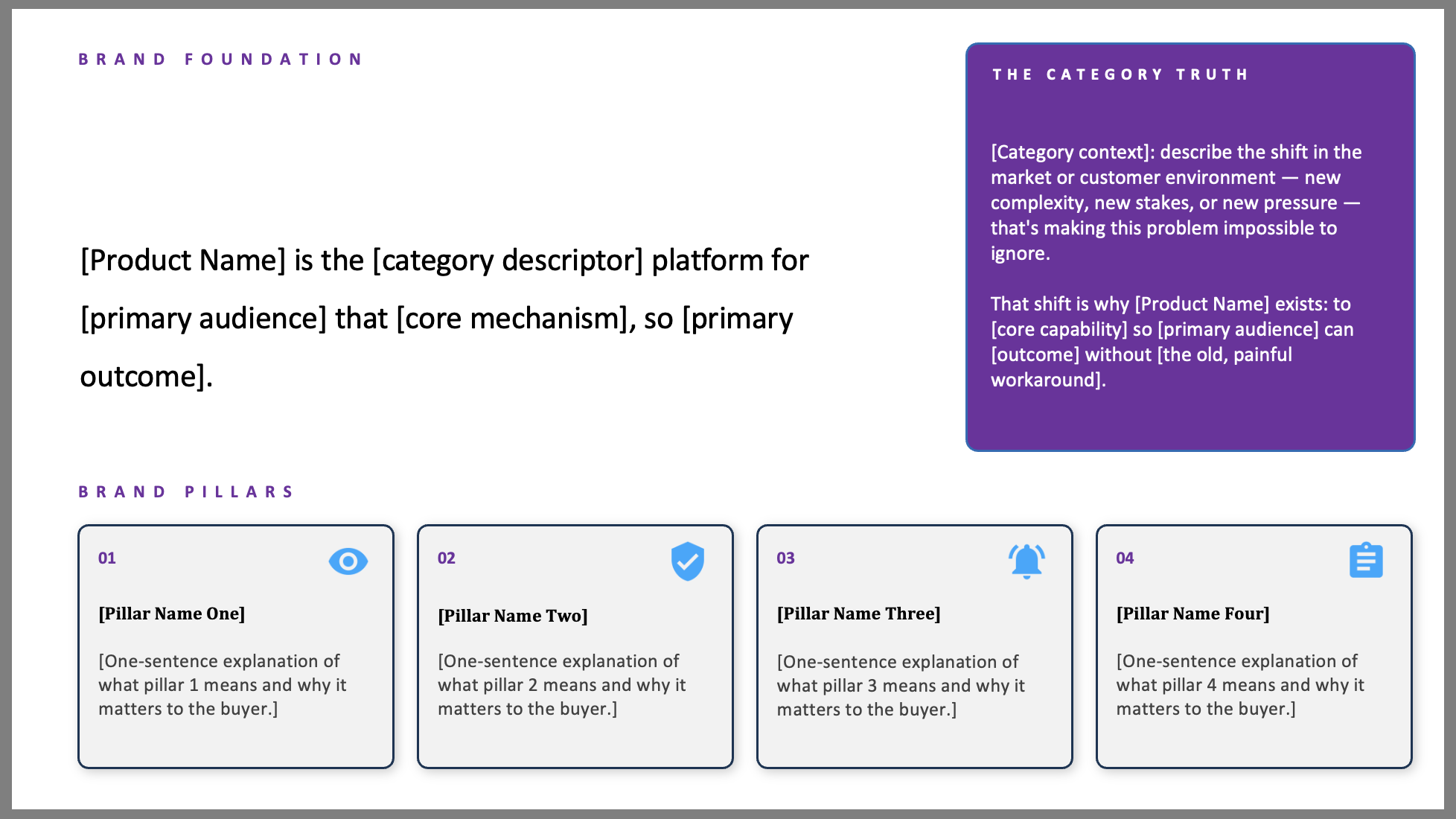
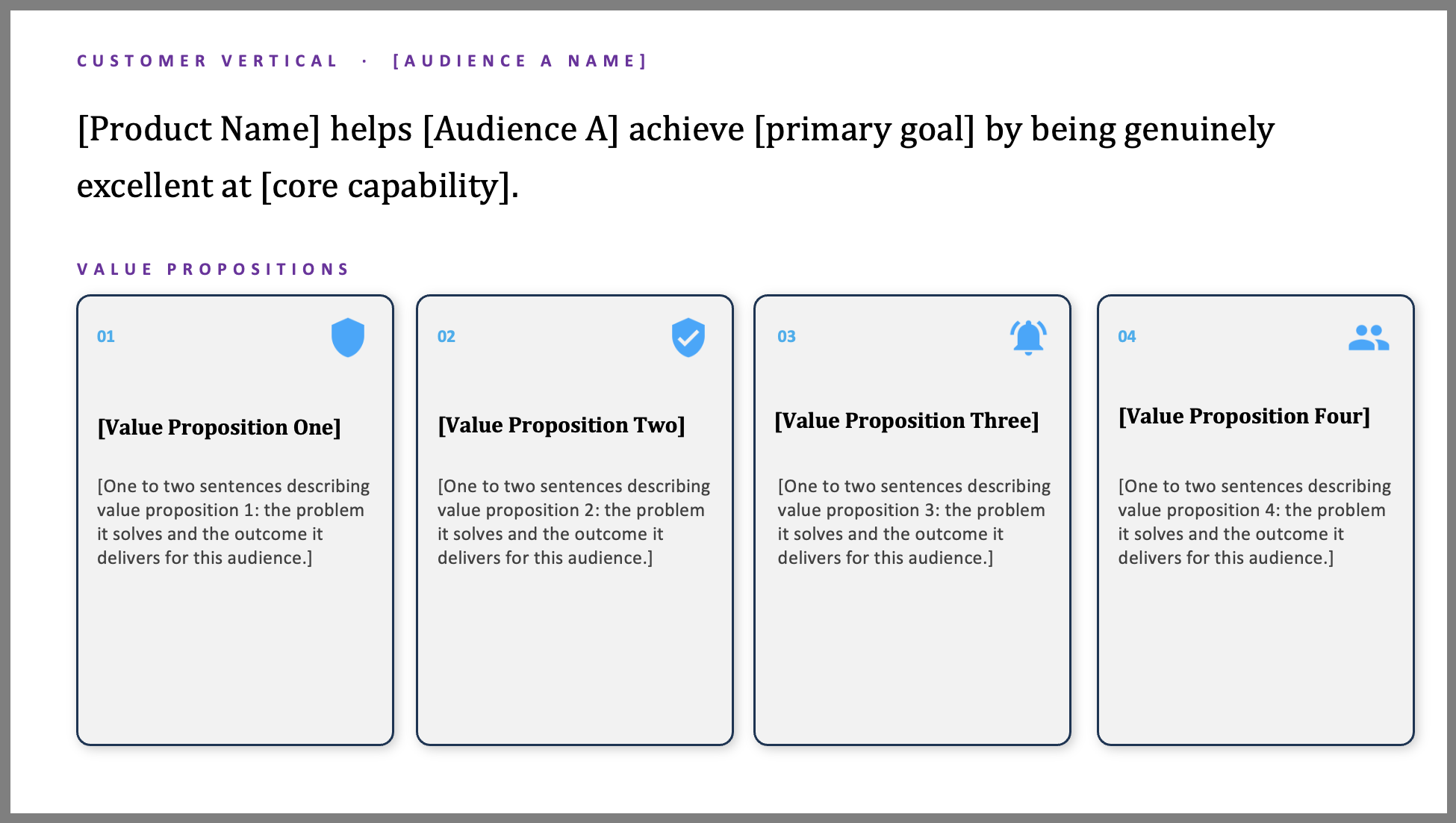
A human still reviews and refines every line before it ships. What changes is where that review starts. Instead of staring at a blank page and drafting positioning from scratch, a strategist is editing a full first draft that’s already grounded in corroborated research, already structured correctly, already using the right language for each audience. That draft used to take days of workshop time to produce. Done this way, it comes back in minutes.
Build a sitemap that follows strategy, not a guess
The brand foundation gives every page a reason to exist. What it doesn’t do yet is decide how many pages, what they cover, or how they’re organized. That’s the sitemap and information architecture (IA) work, and it’s usually the next place teams either burn significant time (workshops, competitor audits, rounds of stakeholder debate over nav structure) or skip the rigor entirely and copy a competitor’s structure without knowing why it works.
Benchmarking the category, fast
Sitemap decisions shouldn’t start from a blank page any more than positioning should. The fastest starting point is understanding how the category’s strongest players structure their own sites: what nav patterns recur, which page types show up across every competitor, and which are table stakes versus genuinely differentiated.
AI search makes this research question answerable quickly instead of over days of manual site audits:
- Pulls and synthesizes competitor site structures across the category in one pass, instead of a human clicking through each site individually
- Identifies recurring page types and nav patterns that signal what buyers expect to find and where
- Separates what’s standard from what’s distinctive, so a team knows which conventions to follow and which represent a real opportunity to differentiate
The human judgment call still matters here. Deciding which conventions to adopt and which to deviate from is a strategic decision, not a research output. AI surfaces the pattern; a person decides what to do with it.
Letting the pillars drive the structure, not the reverse
The brand pillars and audience-specific value propositions already established in the brand foundation work dictate what the sitemap actually needs to contain: a nav section per audience vertical, a page built around each pillar-driven use case, product pages that map to what’s already been positioned.
Sequencing the work this way, sitemap after brand foundation, means IA planning doesn’t turn into a second round of positioning debate. The structure becomes a derivation of decisions that are already made, not a fresh negotiation.
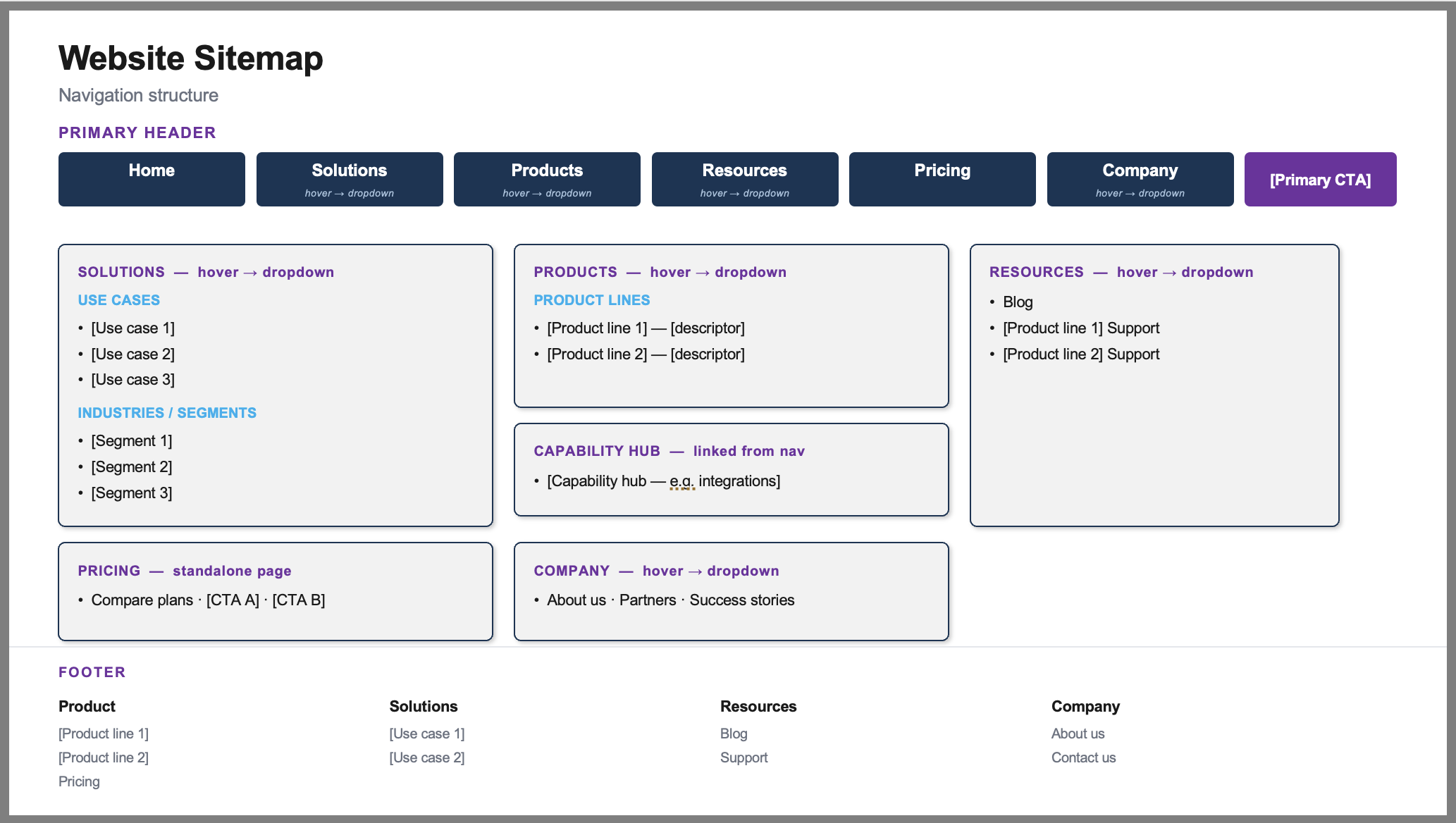
With the pillar structure and the competitive research both in hand, AI drafts a full sitemap directly from them: nav sections, page list, and hierarchy, built from the same inputs that produced the brand foundation rather than assembled page-by-page by a person starting cold.
What used to take a full IA workshop cycle, multiple stakeholder rounds and manually conducted competitor audits, compresses into a fast first draft. A human still validates and adjusts it. They’re just not building it from nothing.
Execute each page type without reinventing it from scratch
Positioning and audience messaging is now all set. The sitemap says what pages need to exist. What’s left is execution: how each individual page actually gets built so it converts. This is where teams either burn time debating page-level conventions from scratch, how many CTAs, how a comparison table should read, or skip the research entirely and default to whatever feels familiar, even when it’s not what the category’s strongest pages actually do.
Treating page conventions as a research question, not a taste debate
Questions like “should this page have one CTA or two” or “how should a pricing and comparison page be structured” feel like design preference. They’re not.
They’re researchable: category-leading sites have already tested these patterns at a scale no single team can replicate internally, and the results are visible in how those pages are actually built.
AI research applies the same approach used to benchmark the sitemap, just aimed at the page level instead of the site level:
- Surfaces how category-leading pages handle a specific pattern: dual-CTA placement, comparison or pricing table structure, industry vertical page conventions
- Identifies why a pattern recurs, not just that it does, so the reasoning transfers even when the exact layout doesn’t
- Covers multiple page types in parallel, since each one is its own research question and none of them benefit from guessing
This keeps every page grounded in what the audience already expects to see, instead of reinventing conventions that are already well established.
Applying the pattern without losing what’s already been decided
The research informs structure and convention: where a second CTA goes, how a comparison table is organized, how many tiers a pricing page shows. It doesn’t inform the actual claims on the page. Those still come directly from the brand foundation and the audience-specific value propositions built earlier in the process.
The human judgment call here is fit, not discovery. A researched convention might be well-proven in the category and still be wrong for a specific brand’s positioning. Deciding which patterns to adopt and which to deviate from is a strategic call, the same kind made when benchmarking the sitemap, just applied one page at a time.
What used to require a slow, page-by-page design-exploration phase compresses into a fast, research-backed starting point. A person still decides what to keep and what to adapt. They’re just not inventing the convention itself each time.
Where AI stops and judgment has to take over
Every step so far has shown AI compressing a specific bottleneck: cross-referencing interviews, reconciling documentation, drafting positioning, benchmarking a sitemap, researching page conventions. All of that is in service of one outcome: a site that actually converts, not just one that ships fast and reads as accurate.
That outcome depends on a few things AI genuinely can’t do, and it’s worth naming them directly.
- Visual and aesthetic judgment. AI can research what a category’s best pages structurally do: where CTAs sit, how a comparison table is organized, what conventions repeat. It can’t originate a distinctive visual identity or make the aesthetic calls that make a brand feel like itself instead of a category-average composite. That distinction is often what actually drives conversion. A page that looks like every other page in the category, even a structurally sound one, blends in instead of building the trust and recognition that gets someone to act. That’s a craft problem, not a research problem, and it stays a human responsibility from first mockup to final page.
- Knowing when to break a convention. Research surfaces what the category’s strongest pages do, and following that pattern is usually the safer bet. But the highest-converting page is sometimes the one that deviates, because the brand’s actual differentiation doesn’t fit the standard mold. Research can’t make that call. It can only tell a team what’s common, not what’s right for this specific brand’s path to conversion.
- Conducting the interviews themselves. A high-converting site still depends on messaging that’s true and specific, and that only comes from interviews a human conducts: reading nuance, following up on an unexpected answer, building the trust that gets someone to speak candidly. AI synthesizes what those interviews produce. It doesn’t run them, and no amount of synthesis speed makes up for a shallow interview.
- Resolving real conflicts between research and brand truth. Research shows what’s well-supported across the category. Occasionally what’s well-supported and what the brand actually needs to say don’t agree. Sometimes the conversion-optimized, well-tested pattern doesn’t fit a brand’s actual claims. Deciding which one wins, and being willing to sacrifice a proven pattern for an honest one, is a judgment call no research output can settle.
None of this undercuts the argument this piece has been making. It completes it. A website that’s accurate, audience-correct, and fast to build only converts if it’s also visually distinct, appropriately differentiated, and built on messaging a human actually earned through real conversation. The speed gained at every earlier step came from compressing research and synthesis, never from removing that judgment. Naming these limits is what separates “AI accelerates the process” from “AI replaces the strategist.”