
Most thought leadership research fails before the survey ever launches. The sample is fine and the analysis is sound, but nobody connected the questions to what the brand actually wants to be known for.
Strong thought leadership data does two jobs at once. It gives your audience something genuinely new to think about, and it reinforces the point of view your brand wants to own. Most studies stop at the first job. Generic questions produce generic findings, and generic findings don’t shift positioning, earn press, or open sales conversations.
The fix starts with the questions. Ask how behavior is shifting, where organizations are putting real money, and what they plan to do next. Then tie each question back to a story your brand needs to tell. Do that well, and your data becomes fuel for positioning, your content calendar, and your sales team for months.
What Thought Leadership Research Is Really About
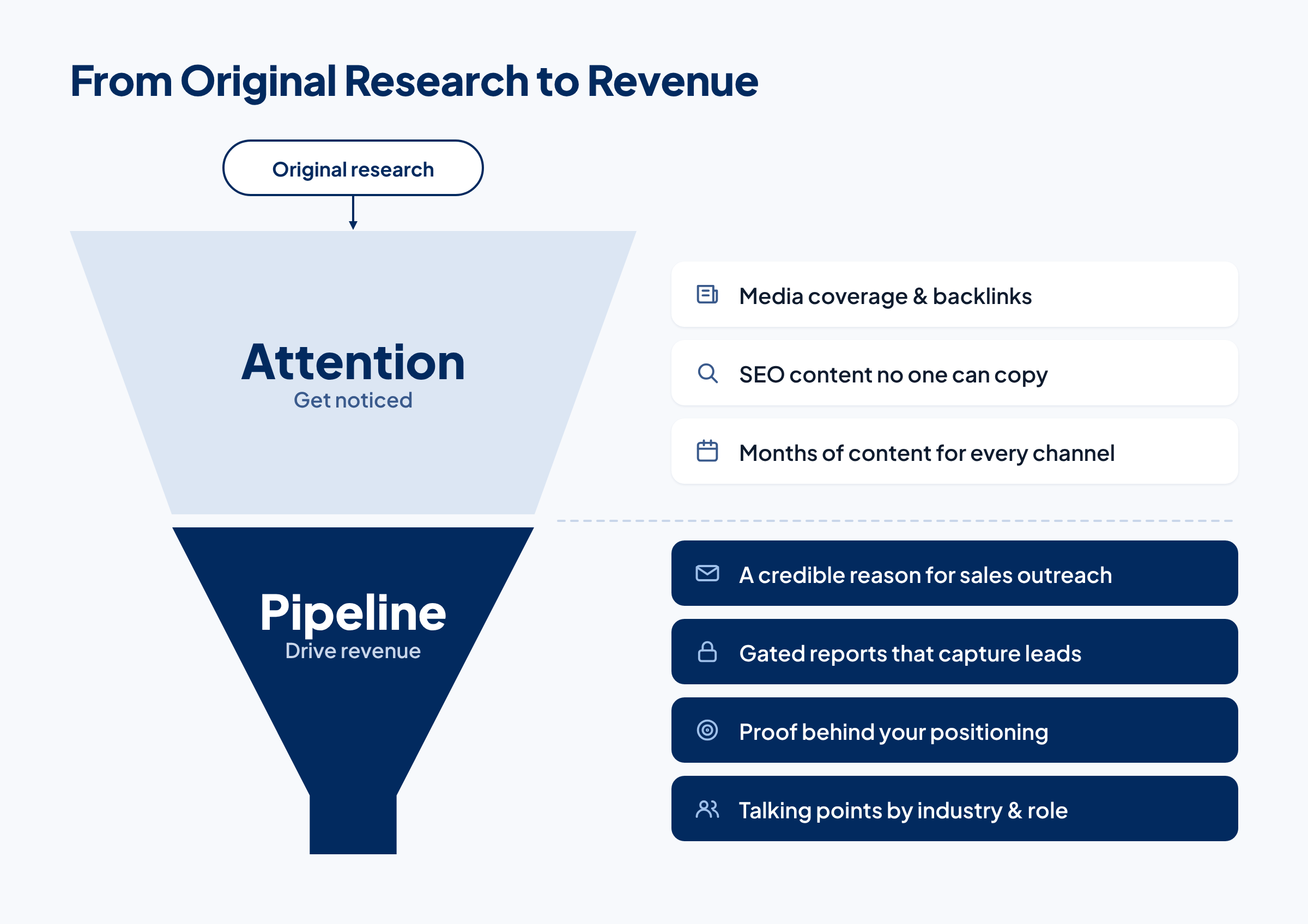
Thought leadership research is original research a company funds to surface new trends, industry shifts, or changing buyer perceptions. The research itself is the means, not the end. The real goal is a point of view your market associates with your brand.
Done well, it delivers on two fronts.
Attention
- Journalists cover fresh data, which earns media mentions and backlinks
- Original findings give your SEO content something competitors can’t copy
- One study can fill your blog, social, email, and webinar calendar for months
Pipeline
- Sales teams get a credible reason to reach out: “We just surveyed 500 IT leaders, and here’s what surprised us”
- A gated full report captures leads who already care about the problem you solve
- Findings validate the pain points behind your positioning, so buyers see their own challenges in your message
- Cuts by industry or role give account teams tailored talking points
The pipeline side only works if you plan for it before you write a single question. That planning starts with the stories you want to tell.
Start With The Stories You Want To tell
Before you draft a single question, decide which stories you want to test. Not the answers you want (that’s how research loses credibility), but the ideas worth investigating.
Strong stories sit where three things overlap:
- Your positioning: the point of view you want your brand to own
- Your buyers’ tension: a problem they feel but can’t quite quantify
- An open question: something the market doesn’t know yet, or gets wrong
To make this concrete, we’ll follow one example throughout this post: a cybersecurity software company planning a thought leadership study. The company positions itself around smarter automation for overstretched security teams. Its candidate stories might include:
- Security teams automate the easy tasks first, not the high-risk ones
- Budgets are shifting from detection tools toward prevention
- Leaders believe they’re ahead of their peers, but adoption data says otherwise
- Burnout, not budget, is the real barrier to modernizing
One useful test: write the headline you hope to publish, then ask whether the opposite result would also make news. If both outcomes are interesting, you have a strong story. If only one works, you’re fishing for confirmation, and journalists and buyers will notice.
Finally, give each story a job. Will it anchor the press release, open a sales email, drive a webinar, or headline the gated report? If a story has no clear role in your marketing or sales motion, cut it.
With your stories in place, you can write questions that feed them. That’s where most studies go wrong.
How To Avoid Generic Thought Leadership
It’s easy to write questions that confirm the obvious. They feel safe, and respondents answer them easily. But obvious data gives you no headline, no reason for a journalist to call, and nothing new for your sales team to say. Here are four common pitfalls, using our cybersecurity example.
Asking Questions Everyone Agrees With
These questions probe on universally accepted values, which leads to near-unanimous answers.
➡ EXAMPLE: Does your organization care about cybersecurity? Yes or No.
Nearly everyone will say yes. A 97% “yes” isn’t a finding; it’s a formality. No journalist will cover it, and no buyer will learn anything from it.
Asking Ambiguous Questions
Ambiguous questions use terms that respondents interpret differently, so the data means something different to each person who answers.
➡ EXAMPLE: Does your organization have a state-of-the-art cybersecurity infrastructure? Yes or No.
One respondent’s “state-of-the-art” is another’s outdated. You can’t build a story on that data, and you can’t defend it when a reporter or a skeptical buyer asks what it actually means.
Asking About Basic Actions
Questions about everyday, widely adopted activities produce predictable answers with little depth.
➡ EXAMPLE: Do you use automation in your cybersecurity monitoring? Yes or No.
Automation is standard in security operations, so expect a wall of yes answers. For our example company, this one hurts. Automation is its core positioning, and this question reveals nothing about where buyers automate, where they don’t, or where the opportunity sits.
Asking Only About Today
Questions about current spending or resources give you a snapshot, not a view of where the market is heading.
➡ EXAMPLE: Do you spend money on cybersecurity? Yes or No.
This confirms the status quo and stops there. It misses whether needs are growing, whether buyers feel satisfied with current tools, or where they plan to invest next. That forward-looking view is what makes headlines, and it’s exactly what sales and product teams want to know.
How To Ask High Quality Thought Leadership Research Questions
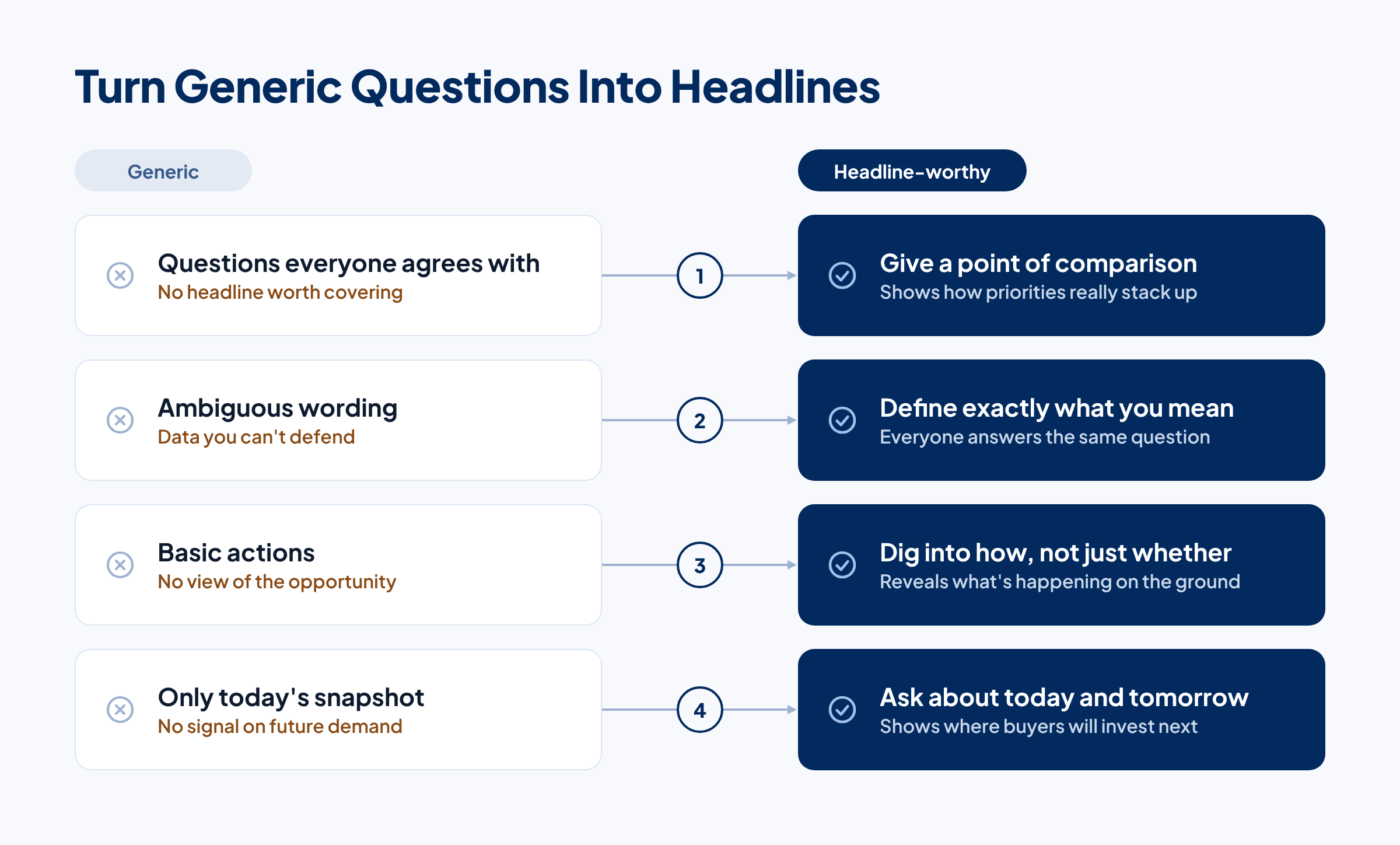
Generic questions come from shallow prompts. Strong questions add specificity, measure real behavior, and look ahead. Each one should also produce a finding you could actually publish. Here’s how to fix each pitfall.
Give Respondents A Point Of Comparison
Instead of asking whether something matters, ask how it stacks up against something else. A comparison set shows how much a priority actually drives decisions.
➡ BEFORE: Does your organization care about cybersecurity? Yes or No.
➡ AFTER: How has your organization’s investment in cybersecurity software changed relative to other IT operations software in the past 12 months?
- Increased a lot compared to other IT Ops areas
- Increased a little compared to other IT Ops areas
- Stayed about the same as other IT Ops areas
- Decreased a little compared to other IT Ops areas
- Decreased a lot compared to other IT Ops areas
Potential headline: “X% of IT leaders grew security spending faster than any other IT area”
Define Exactly What You’re Asking About
Concrete terms remove the guesswork, so every respondent answers the same question. That makes your findings defensible when a reporter or buyer pushes back.
➡ BEFORE: Does your organization have a state-of-the-art cybersecurity infrastructure? Yes or No.
➡ AFTER: Which of the following cybersecurity tools does your organization use today? Select all that apply.
- AI-powered threat detection
- Zero trust network access
- Automated incident response
- AI-driven phishing and social engineering detection
- None of the above
Rather than letting respondents define “state-of-the-art,” this version defines it for them.
Potential headline: “Only X% of organizations use AI to detect phishing attacks”
Dig Into How, Not Just Whether
Go beyond basic actions to explore where and how organizations carry them out. This turns surface-level data into a detailed view of what’s happening on the ground.
➡ BEFORE: Do you use automation in your cybersecurity monitoring? Yes or No.
➡ AFTER: In which of the following areas, if any, does your organization currently use automation? Select all that apply.
- Asset inventory management
- Backup monitoring
- Compliance reporting
- User account management
- Certificate and key management
- None of the above
For our example company, this question directly tests one of its candidate stories: that teams automate the easy tasks first.
Potential headline: “Security teams automate backups, not access: X% automate backup monitoring vs. Y% for user accounts”
Ask About Today And Tomorrow
Answer options tied to both current use and future plans show where organizations sit in the buying journey.
➡ BEFORE: Do you spend money on cybersecurity? Yes or No.
➡ AFTER: Which of the following best describes your organization’s investment in vulnerability management software?
- We don’t use it today and have no plans to invest
- We don’t use it today, but are considering investing
- We use it today and expect our investment to stay about the same
- We use it today and plan to increase our investment
This reveals future demand, which matters to more than your content team. Sales can use it to size the opportunity, and product can use it to prioritize.
Potential headline: “X in 10 organizations plan to increase vulnerability management investment next year”
From Questions To Pipeline
Good questions are where your strategy turns into data. Before you field your study, run every question through four checks:
- Does it feed one of your core stories?
- Could the answer surprise someone, in either direction?
- Could you defend the wording to a journalist?
- Does it give sales or product something they can use?
If a question can’t pass these checks, rewrite it or cut it. A tighter survey also means better completion rates and cleaner data.
Then plan how your findings will travel. Decide which story leads the press release, which stats go to your sales team, and what sits behind the gate. The studies that earn the most attention and pipeline have a launch plan before they have data.